





 English
 French


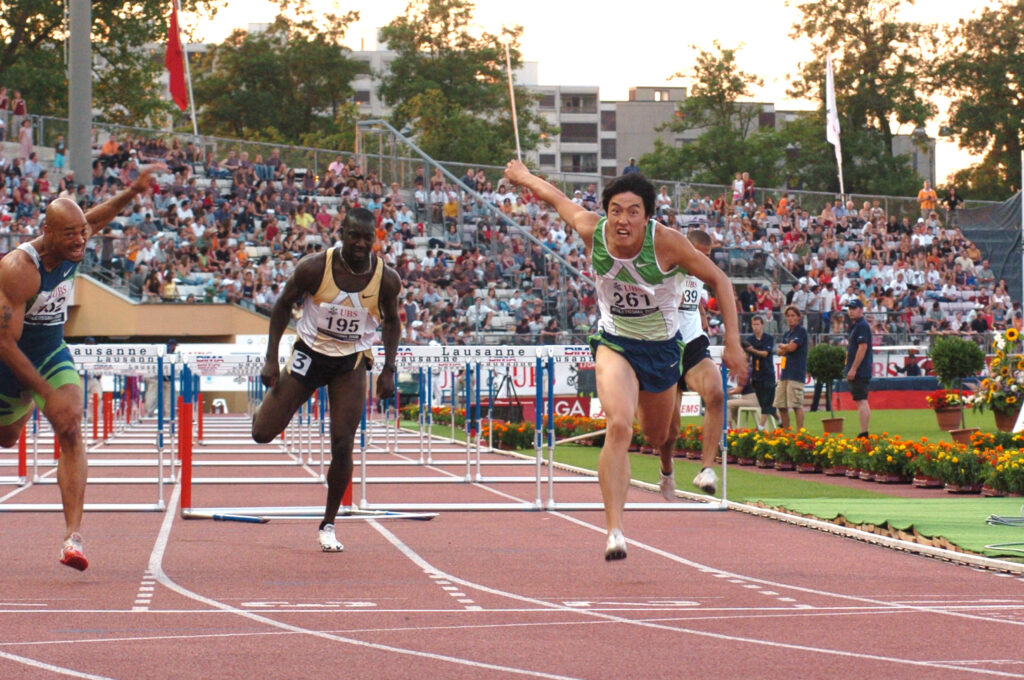
Twenty years ago, on 11 July 2006, Athletissima witnessed a performance that left a lasting mark on athletics: Liu Xiang’s world record in the 110 metres hurdles. Already an Olympic champion, the Chinese star entered a new realm that day, forging a legacy that still extends far beyond his country’s borders and placing Lausanne firmly on the sporting map of an entire continent.
Far more than just a world record, Liu Xiang’s 12.88 marked a turning point. For the first time, a Chinese athlete proved that it was possible to challenge the world’s leading nations in a sprint event. It was a powerful symbol that would profoundly shape Chinese sport.
China had, of course, already experienced the success of the women known as “Ma’s Army”, led by Wang Junxia, who shattered long distance and middle distance world records in the 1990s. Yet, remarkable though their achievements were, their impact was never comparable to Liu Xiang’s.
Today, with a Chinese company, Wanda, serving as title sponsor of the Diamond League, and with Shanghai and Xiamen hosting some of the world’s premier athletics meetings, it is reasonable to believe that Liu Xiang’s achievements, particularly his performance in Lausanne, helped pave the way for this growth.
The Announcer Erupts
On that 11 July 2006 evening at the Pontaise Stadium, Liu Xiang did not enjoy the best of starts. French world champion Ladji Doucouré burst from the blocks, as did American Dominic Arnold, in a final featuring the very best in the event, including Dayron Robles and Terrence Trammell. But Liu Xiang was the finest technician in the field. Barely brushing the hurdles, he produced a race of remarkable smoothness, crossing the line in 12.90, a time revised moments later to 12.88, three hundredths of a second faster than the previous world record.
“Annihilated, the world record is gone!” the announcer exclaimed. Press chief Pierre André Pasche and meeting director Jacky Delapierre immediately rushed over to congratulate the Chinese star, with Jacky embracing him warmly. Beaming, Liu Xiang climbed onto the timing board, sat on top of it, waved his arms and roused the now captivated Pontaise crowd.
It was a historic moment. Liu Xiang became the first Chinese male athlete to set a world record and the first Asian ever to dominate a sprint or hurdles event. A year later, in Osaka, he would also become the first hurdler to hold the Olympic title, the world title and the world record simultaneously.
Lausanne came to symbolize a carefree moment in time. Two years later, at the Beijing Olympic Games, the national hero carried the expectations of an entire people on his shoulders. But his story took a tragic turn. Suffering from a serious Achilles tendon injury, he refused to withdraw before the start. Grimacing in pain and already struggling to clear a hurdle during the warm up, he nevertheless took his place in the blocks, only to find himself unable to start. The pain was simply unbearable.
The episode left a deep imprint on the history of Chinese sport. It lent a tragic dimension to Liu Xiang’s career without ever diminishing his immense legacy.
Thanks to him, the spotlight in China turned for a time toward Lausanne, where he had already set the world junior record in 2002. Few world records can claim to have left such an enduring mark, extending far beyond the achievement itself. Even today, Chinese visitors still come to see the commemorative plaque at the Pontaise Stadium marking that world record.